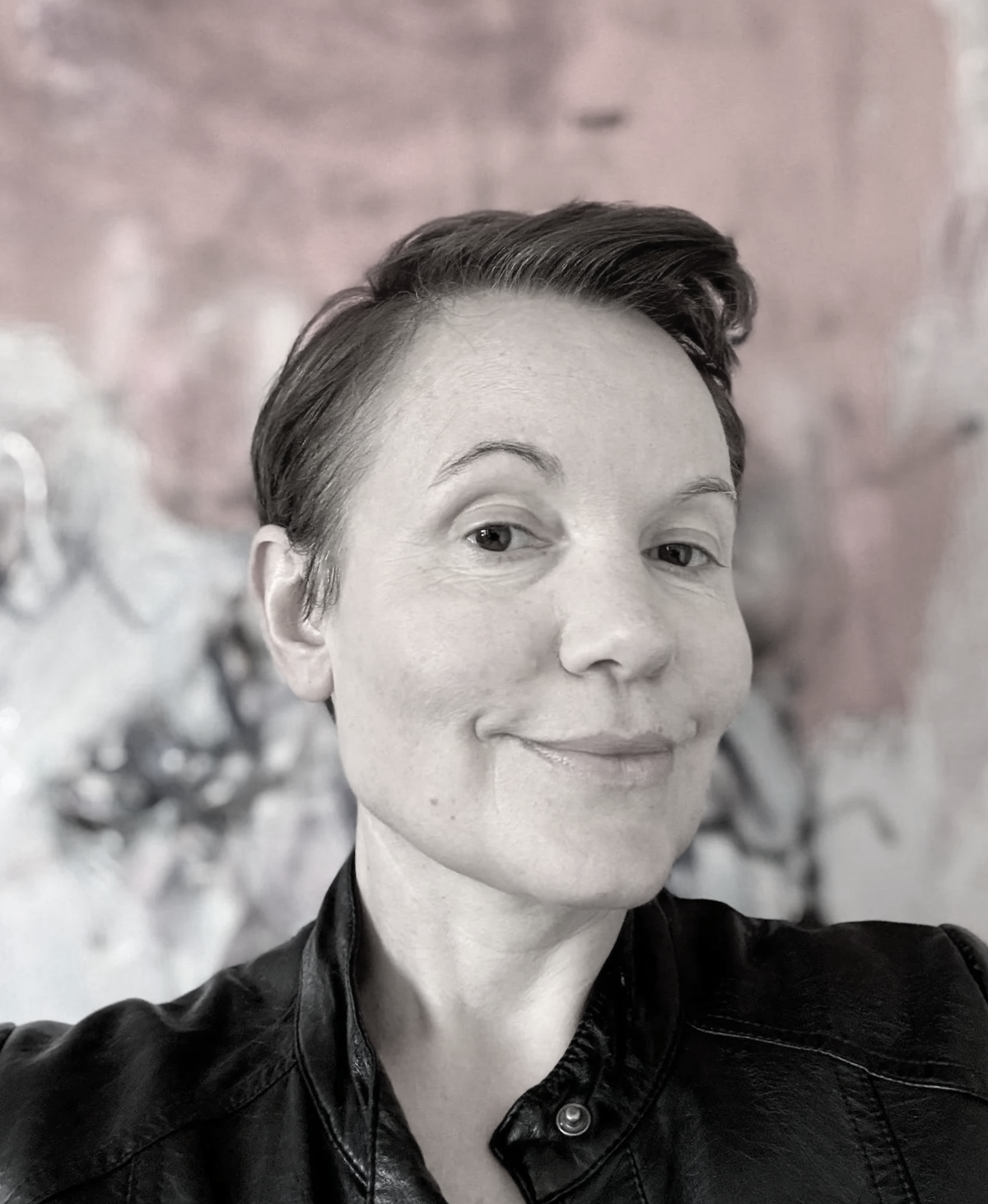
BIO
Sarune Kaupas (b. 1976, Lithuania) is a visual artist based in Oslo. She holds an MA in Fine Art from the Vilnius Academy of Art (2001–2003). Her work moves between gestural, colour-driven painting, hand-cast soap objects, and pieces built from institutional response letters — examining the legal, bodily and administrative borders that decide what counts as belonging, danger, or worth keeping.
ARTIST STATEMENT
I work with borders other people have drawn – legal, bodily, institutional, commercial – and examine what happens to the material in the second before the border decides anything. Not what the border means, but what it does while it is still working.
Citizenship is one such border. In Ius Sanguinis / Ius Domicilii: Stateless Soil I use soil from two gardens – one in Oslo, one in Vilnius – as paint. The soil is not a picture of the place; it is the place, brought into the work unprocessed. Lithuania does not allow dual citizenship; I had to choose, and the law chose for me while I could still sing both national anthems by heart. The project insists that the question "which am I more of?" is not rhetorical but legal – ius sanguinis and ius domicilii are actual legal principles, not borrowed metaphors. I scratch letters into soil surfaces the way children carve initials into tree trunks: a primitive I was here, claimed with the body because the paperwork no longer will.
The body has its own borders, much faster than the law's. In Cherries and Wasps (Kirsebær og veps) I paint the second a smell or a taste reaches the spine before the brain has decided whether it is danger or delight. A cherry is sweet until the wasp lands on the same skin. This is not a project about childhood – it is an inquiry into a state that recurs throughout life, every time the body registers something before thought has time to sort it. The layers in the paintings follow the same logic as the subject: some pictures are settled in one move, before doubt arrives; others build over weeks, where a dry layer meets a new one that doesn't know what lies beneath. The process can never be more decided than the moment it tries to hold.
Institutions have a third kind of border, slower and more bureaucratic. We Thank You for Your Interest (Vi takker for din interesse) takes as its starting point the standardised responses I have received from applications to exhibitions and grants – a phrase that usually ends a dialogue, used here as a beginning. Every response, regardless of outcome, triggers a three-part movement: one manual mark on an already-rejected painting (Register), one postcard added to the archive (Archive), one large canvas realised when the answer is yes (Response). Yes and no are treated the same – it is not the rejection that is the material, but the fact that a response arrives at all. The project grows with my own application practice, including this one: applying to show We Thank You for Your Interest is itself a new event the work will register.
The same unrealistic hope has a commercial variant. In Limited Edition I hand-cast and engrave soap with phrases borrowed from the language of beauty and advertising – SPIRIT SHINE, MIND CLEAN, PEACE SHINE, WAR SCRUB – letting the promise flicker between sincere and absurd. Cure Kit is finished, four soaps in metal tins; Peace Factory is in progress, up to a hundred cubes sold as art in a universe where war and peace are competing products on the same shelf. The soap dissolves as it is used, so the promise of cleansing can never be verified – only repeated. It is the same naive hope as singing a national anthem to stop something enormous: that one small, concrete thing could dissolve something far larger than itself.
Four borders, four timescales – a law that operates across generations, a smell that operates in a microsecond, a letter that operates over weeks, a bar of soap that operates until it is gone. What I am looking for is the same place every time: the moment the border hasn't yet decided anything, and the material can still go either way. I let soil, colour, mark, paper and soap carry that uncertainty instead of explaining it away. None of these projects is finished in the usual sense – they are ongoing registrations that continue for as long as the borders that made them do.
Sarune Kaupas
CV
Education
Master of Arts in Visual Arts (Site-Specific Art, Stained Glass)
Vilnius Academy of Arts, Lithuania, 2001–2003Bachelor of Arts in Visual Arts (Site-Specific Art, Stained Glass)
Vilnius Academy of Arts, Lithuania, 1997–2001
Selected Solo Exhibitions
2027 Ius Sanguinis / Ius Domicilii: Stateless Soil, Drobe Art Gallery, Kaunas, Lithuania — forthcoming
2025 Derailment, Tveten Gård Gallery, Oslo, Norway
2024 I Am Here, Grolitt Festival, Deichman Romsås, Oslo, Norway
2019 Colourless Encounter, Galera Gallery, Vilnius, Lithuania
2010 Mini, Pamenkalis Gallery, Vilnius, Lithuania
2007 Silence II, Langas Gallery, Kaunas, Lithuania
2007 Nord, KKC, Klaipeda, Lithuania
2006 In/Jan, SJMD Gallery, Vilnius, Lithuania
2005 Silence I, Ruta Gallery, Vilnius, Lithuania
Selected Group Exhibitions
2026 Dikemark Art Biennale (jury-selected), Norway.
2026 Art That Sucks, Kunstakademiet, Seilduken, Oslo, Norway.
2026 Provocative Art, Fredrikstad Kunstforening, Norway.
2026 Bridge, Lillestrøm Kunstforening (jury-selected), Norway.
2026 Walk, Dalalåven Atelier, Norway.
2026 Oslo Open, TrAP, Oslo, Norway.
2025 What Is Life Without..., Lillestrøm Art Association, Norway
2025 100imagesmqmm, Spazio Magma, NABA Roma, Italy
2024 EAST ART, Alna Bydelshus, Oslo, Norway
2020 NFUK Juryed Digital Biennale, Norway
2018 For Children, Lithuanian Embassy, Oslo, Norway
2007 Art in the Appletons City Park, Appleton, USA
2001–2002: International Stained Glass Symposium 1+1, Riga (LV) & Vilnius (LT)
Artistic Commissions & Public Art
2023 Forest, mural, Benterud Kindergarten, Lørenskog, Norway
2015 Colours, mural, IKT Support, Åndalsnes, Norway
2005 Stained glass, St. Anton, Lukiskes Prison Chapel, Vilnius, Lithuania
2001 Stained glass, St. Maria, Holy Trinity Church, Troskunai, Lithuania
Awards & Grants
2026 Grant for the art project K-VINNER – KUNST VINNER Regional Culture Fund Oslo
2025 Grant for the art project K-VINNER – KUNST SPIRER Regional Culture Fund Oslo
2007 Grant for art project “Lithuanian Small Towns’ Cultural Heritage Through the Artist’s Eyes”, Lithuanian Council for Culture
Memberships
2026 BO – Billedkunstnerne i Oslo